
Level 2 vs Level 3 Personal Training
What each qualification actually covers, and whether you need both.
Becoming a PT
The realistic path from "I want to do this" to qualified and working with clients — qualifications, timeline, cost and what actually separates a good course from a box-ticking one.
By James McKeen, Course Tutor · Published 15 September 2026 · 8 min read
The qualifications you actually need
To work as a personal trainer in the UK and see clients one-to-one, you need two qualifications: a Level 2 Gym Instructor qualification and a Level 3 Personal Training Diploma. Level 2 on its own qualifies you to instruct people safely on gym equipment and run inductions — it does not qualify you to write programmes, screen clients or train them one-to-one for a fee. Level 3 is what actually makes you a personal trainer.
Some providers sell these as two separate bookings; others, including Edinburgh PT Academy's course, teach them as one combined 10-week programme so you progress from Level 2 into Level 3 without a gap or a second enrolment. For a full breakdown of what each level actually covers, see our Level 2 vs Level 3 guide.
Whichever provider you choose, check that the qualification is CIMSPA-approved and Ofqual-regulated — that's what UK gyms and insurers actually check for before letting you work. We go into why that matters in our CIMSPA vs REPs guide.
Timeline
Most combined Level 2 and Level 3 courses run 10 to 16 weeks, depending on how much of the course is self-paced online theory versus timetabled in-person practice. Fully online-only routes can look shorter on paper, but if there's no supervised practical assessment built in, you're likely to spend extra time afterwards building confidence you didn't get during the course itself.
A blended structure — online theory you work through at your own pace, paired with a fixed number of in-person practical hours — tends to be the realistic middle ground: fast enough to start a career change without dragging on for a year, but with enough supervised floor time that you're not learning to coach for the first time in front of a paying client.
What to look for
Course marketing tends to sound similar across providers, so it's worth checking the specifics before you enrol:
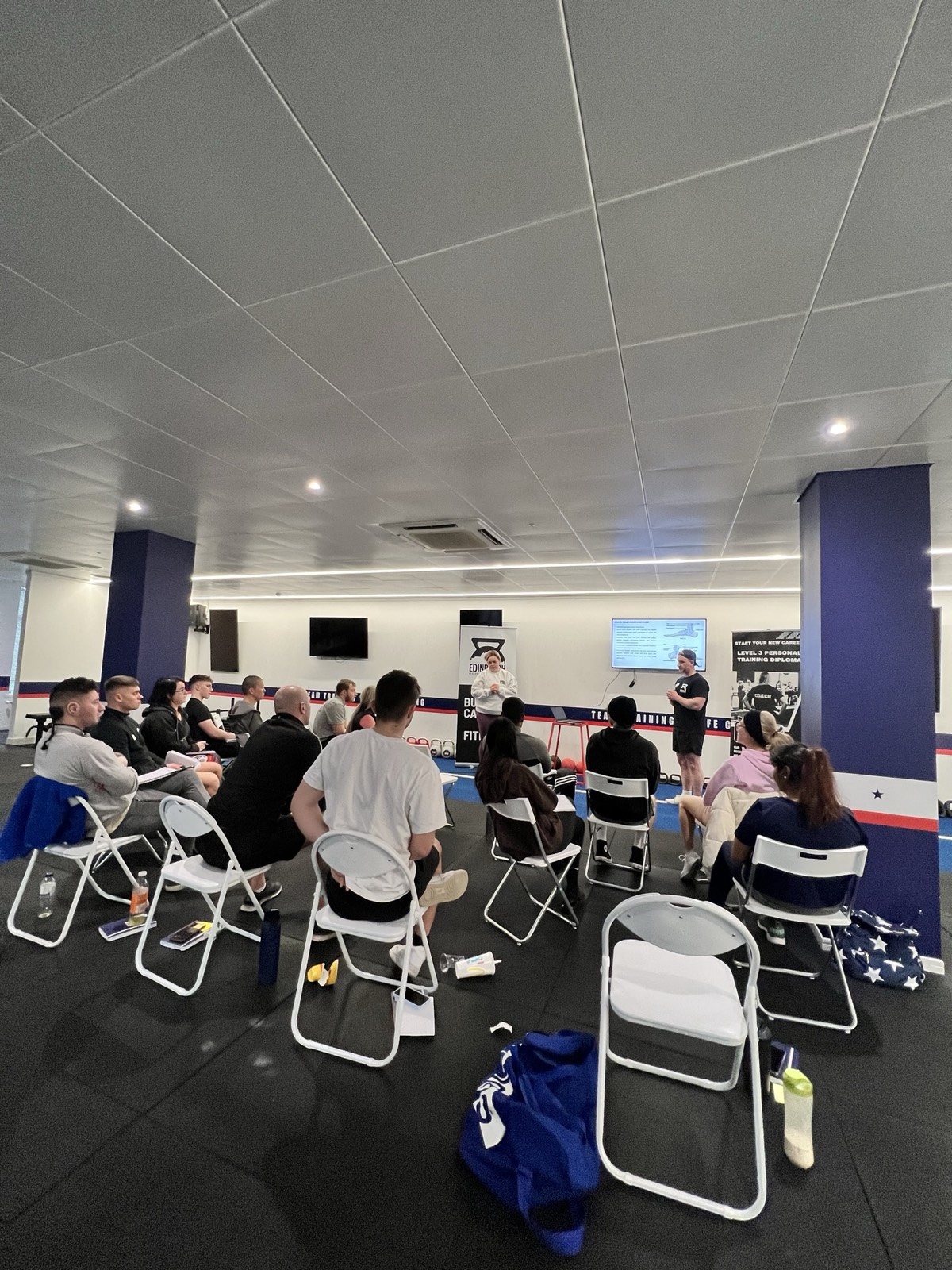
Edinburgh PT Academy's course, for example, is built around 40 hours of in-person, tutor-supervised gym practice on top of self-paced online theory, with cohorts capped at 8–12 students — a deliberate choice to keep the practical side genuinely practical rather than a checklist exercise. See the full course structure, cost and entry requirements.
Cost
UK prices for a combined Level 2 and Level 3 qualification vary widely — cheaper online-only bundles start lower, while in-person and blended courses with real supervised practice typically cost more because they involve tutor time, venue costs and smaller cohorts. We've broken down what actually drives the price in our personal trainer course cost guide, including where Edinburgh PT Academy's £1,850 all-inclusive fee sits in that range.
In-person vs online-only
Online theory is fine for the knowledge side — anatomy, physiology, programming principles. What it can't replicate is a tutor standing next to you, watching you coach a real person, and correcting your cueing, your positioning and your communication in the moment. Personal training is, at its core, a communication skill practised in front of another human being. You can read about client screening; you can't fully learn to run one without doing it under supervision and getting told what you missed.
That's the reasoning behind building a course around real practical hours rather than treating them as an add-on — certified is not the same as ready to coach a client on day one of the job.
Career paths
Graduates typically go one of several ways: employed personal trainer in a commercial gym, self-employed PT renting floor space or running outdoor sessions, online coaching, or a gym instructor/class-based role while building toward full PT work. A good course should include some grounding in the business side — pricing, client acquisition, setting up as self-employed — since qualifying is only the first half of actually earning from it. For a realistic sense of what PTs earn across these different routes, see our personal trainer salary guide.
Common questions
Most combined Level 2 and Level 3 courses take between 10 and 16 weeks, depending on how the provider blends online theory with in-person practical hours. Fully online-only routes can be shorter on paper but usually don't include supervised practical assessment.
No. Reputable Level 2 and Level 3 courses are built for complete beginners as well as career changers. A general level of personal fitness helps, but you don't need prior coaching experience or a fitness-industry background to enrol.
Level 2 (Gym Instructor) covers anatomy, physiology and safely instructing people on gym equipment. Level 3 (Personal Training Diploma) adds client screening, programme design, nutrition guidance and the business side of working as a PT. You need both to call yourself a personal trainer and work one-to-one with clients; Level 2 alone qualifies you as a gym instructor.
Related reading
What each qualification actually covers, and whether you need both.
UK price ranges and what drives the cost up or down.
What employed and self-employed PTs realistically earn.