Choosing a course
Best Personal Trainer Course in Scotland: How to Choose the Right One
The best personal trainer course in Scotland is a combined Level 2 Gym Instructor and Level 3 Personal Training qualification that is CIMSPA-endorsed, includes supervised practical hours with a named tutor, and has one clear all-in price. Your location, schedule and budget then decide between a private provider, a college HNC or an online route.
The honest starting point
What makes a personal trainer course the best one in Scotland?
No single course is best for everyone. The strongest option is the one that gets you a recognised Level 3 qualification and the ability to coach a real client. That comes down to four things you can check yourself: accreditation, supervised practical hours, cohort size and a price with nothing added later.
Most "best course" lists don't show their scoring. One widely shared UK roundup, updated in August 2026, lists eleven providers "in no particular order" and gives no criteria beyond reputation. That's why this page gives you a scorecard rather than a ranking. You can use it on any provider, including us.
Your options
Which routes lead to a PT qualification in Scotland?
Scotland has three realistic routes to working as a personal trainer, and they sit on two different qualification frameworks.
1. A private provider's Level 2 and Level 3 diploma
This is the most common route. Private academies deliver Ofqual-regulated diplomas from awarding bodies such as Active IQ, usually as one combined Level 2 and Level 3 package. Formats range from a few intensive weekends to around 10 weeks of blended study. None of them ask for school qualifications to start.
2. A college HNC plus a PDA in Personal Training
Scottish colleges, including City of Glasgow College, Fife College, West Lothian College and Dumfries and Galloway College, run the HNC Fitness, Health and Exercise at SCQF level 7. It is typically a year of full-time study. The SQA's PDA Personal Training is also at SCQF level 7 and has five mandatory units. According to the SQA, completing the HNC together with the PDA lets you register with CIMSPA as a Personal Trainer Practitioner. City of Glasgow College asks for two Highers at grade C or above (including English), or an equivalent.
3. An online course from a UK-wide provider
National providers sell online-only courses into Scotland. You study the theory on screen, then film your practical sessions for marking. It's the cheapest and most flexible route, and the one with the least supervised coaching. We compare it in detail in our online personal trainer course guide.
Side by side
What do PT courses in Scotland cost, and how are they taught?
| Provider | Where in Scotland | Qualification | Format | Advertised price |
|---|---|---|---|---|
| Edinburgh PT Academy | Gorgie, Edinburgh (EH11) | Level 2 + Level 3 Diploma, CIMSPA-approved, Ofqual-regulated | 10 weeks blended; 40 in-person hours; 8–12 per cohort | £1,850 all-inclusive |
| The Fitness Education Academy | Penicuik base; Glasgow, Edinburgh, Fife, Aberdeen | Active IQ Level 2 Certificate + Level 3 Diploma | In-person | £1,800 package (listed as a special offer) |
| OriGym | Edinburgh College, Sighthill (EH11) | Level 2 & 3 Diploma, CIMSPA-endorsed, Ofqual-regulated | Online study + weekend workshops and assessments | From £1,499 |
| Fitness Training Scotland | Scotland (venue varies by date) | Active IQ Level 3 Diploma only; Level 2 needed first | 6 days: 2 online, 4 face-to-face over 3 weekends | £1,395 (Level 3 only) |
| Scottish colleges | e.g. Glasgow, Fife, West Lothian, Dumfries | HNC Fitness, Health & Exercise (SCQF 7), plus PDA Personal Training (SCQF 7) | Around 1 year, full time | Not listed — ask the college |
| HFE (online) | UK-wide, online | Online PT Essentials package, CIMSPA-endorsed | Self-paced, up to 12 months; filmed practicals | £1,165 paid in full |
Prices are as advertised on each provider's own website, checked 28 September 2026. Offers change often, so confirm the current price and what it includes before you book.
The scorecard
How do you compare personal trainer courses? A 7-point checklist
Put each course you're considering through these seven checks. Any "no" should get a clear explanation from the provider before you pay.
- CIMSPA endorsement for Level 3. Ask for the awarding body and qualification title, then check the course is listed on the CIMSPA Careers Hub. Our CIMSPA vs REPs explainer covers why this matters more than any logo.
- Supervised practical hours, as a number. "Practical workshops" could mean one day or forty hours. Ask exactly how many hours a tutor watches you coach.
- Where your practical assessment happens. Some national providers have Scotland landing pages but no Scottish venue listed. Find out whether you'll travel, be assessed in Scotland or submit video.
- Cohort size. Twelve students to one tutor and thirty to one are very different courses.
- Named tutors. You should be able to find out who teaches you and what experience they have.
- One all-in price. Check whether exams, resits, registration and portal access are included. Our PT course cost breakdown lists what to ask.
- A schedule you can finish. Weekends, weekday evenings, a college year or 12 months online: pick the one that fits your working week.
Cost
How much does a personal trainer course cost in Scotland?
As of September 2026, private Level 2 and Level 3 packages in Scotland are advertised at roughly £1,500 to £1,850. A Level 3-only course for people who already hold Level 2 starts at around £1,395. Online-only packages come in lower, for example £1,165 paid in full with HFE.
The difference usually reflects tutor time and venue costs, not the certificate itself. A cheaper online course and a £1,850 blended course can lead to the same Level 3 qualification. What you're paying extra for is supervised practice. If you're choosing between two prices, compare cost per supervised hour, not the headline figure. For reference, EPTA's £1,850 fee covers 40 supervised hours, exams and portal access.
Full disclosure
Where does Edinburgh PT Academy fit among Scottish PT courses?
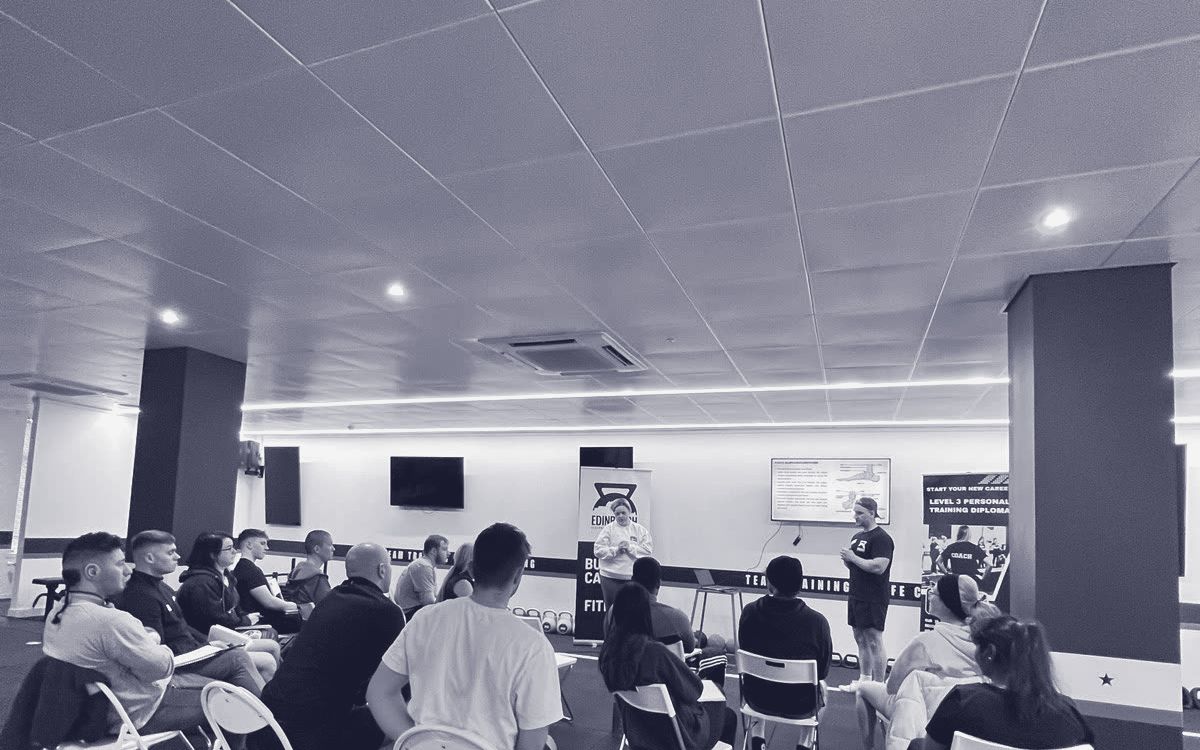
We're one of the providers in the table, so read this section with that in mind. Edinburgh PT Academy teaches a combined Level 2 Gym Instructor and Level 3 Personal Training Diploma, CIMSPA-approved and Ofqual-regulated, over 10 weeks. You do the theory online through the AITP Student Hub. You then spend 40 hours coaching in the gym (see the 10-week syllabus) at 545–551 Gorgie Rd, with no more than 8–12 students per intake.
It suits people in and around Edinburgh who want lots of supervised practice and can travel to Gorgie. If you need a full college year, a Glasgow or Aberdeen venue, or the lowest possible price, another route in the table may suit you better. You can check the entry requirements and next intake dates, or see how a typical week on the course runs.
Frequently asked questions
Is a personal trainer qualification from an English awarding body valid in Scotland?
Yes. CIMSPA's professional standards apply across the UK. Ofqual-regulated Level 3 diplomas, such as those from Active IQ, are taught by many Scottish providers. Employers mainly check for CIMSPA endorsement and a recognised awarding body, not which UK regulator oversees the qualification.
What is the difference between an HNC Fitness, Health and Exercise and a PT diploma?
The HNC Fitness, Health and Exercise is a college qualification at SCQF level 7, usually taken full time over a year. A private PT diploma is a shorter Ofqual-regulated Level 2 and Level 3 package. For personal training specifically, the SQA says you complete the HNC together with the PDA Personal Training to register with CIMSPA as a Personal Trainer Practitioner.
How long does a personal trainer course take in Scotland?
It depends on the route. A Level 3-only course for people who already hold Level 2 can run over three weekends. A combined blended course such as Edinburgh PT Academy's takes 10 weeks. A college HNC is typically one year full time, and online packages usually give you up to 12 months.
Do I need Highers to become a personal trainer in Scotland?
Not for private provider courses, which have no formal academic entry requirements. College HNC routes are different: City of Glasgow College, for example, asks for two Highers at grade C or above including English, or an equivalent. The SQA's PDA Personal Training has no formal entry qualifications.
Are there weekend personal trainer courses in Scotland?
Yes. Several Scottish providers run practical workshops and assessments at weekends. OriGym runs its Edinburgh workshops on weekends, and Fitness Training Scotland's Level 3 course runs over three consecutive weekends. Check how many supervised hours a weekend format actually includes.
Which awarding bodies are common for PT courses in Scotland?
Active IQ is one of the most widely used awarding bodies among private providers in Scotland, and colleges award SQA qualifications such as the HNC and PDA. Whatever the body, ask for the exact qualification title and confirm it is CIMSPA-endorsed.
How do I check that a PT course is CIMSPA-endorsed?
Ask the provider for the awarding body and the full qualification title, then search for the course on the CIMSPA Careers Hub. If a provider can't tell you the awarding body, treat that as a warning sign.
Is the cheapest personal trainer course a bad choice?
Not automatically. A lower price often means less tutor time and more self-filmed assessment, not a weaker certificate. It's a bad choice if you need supervised coaching practice to feel ready for real clients and the course doesn't provide it.
Can I study a personal trainer course in Scotland around a full-time job?
Yes. Blended courses put the theory online so you can study in the evenings, and weekend-based courses keep the in-person sessions away from your working week. College HNCs are usually full time, which is harder to fit around a job.
Do Scottish college fitness courses include a gym instructor qualification?
Some do. City of Glasgow College says its HNC Fitness, Health and Exercise includes gym instructor accreditation. Check each college's course page, because content varies between colleges.
Should I choose a PT course near where I want to work?
It helps. Tutors and fellow students give you local gym contacts, and you avoid travelling to a practical assessment. It isn't essential, though, because a CIMSPA-endorsed Level 3 qualification is recognised by gyms across the UK.
Related reading
Keep exploring
Qualifications
What Qualifications Do You Need to Be a PT?
The full checklist: Level 2, Level 3, insurance, first aid and PVG.
Cost guide
How Much Does a Personal Trainer Course Cost?
UK price ranges and what drives the cost up or down.
Course format
Online Personal Trainer Courses in the UK
How online PT courses assess you, and what they can't teach.