
Course guides
What to Expect on a Personal Trainer Course, Before You Enrol
On a personal trainer course you'll study anatomy, physiology, nutrition, programme design and the business of personal training, and practise coaching real people. You're assessed in three ways: online multiple-choice exams, written coursework, and a practical observation where an assessor watches you train a client. Most combined Level 2 and 3 courses take 10–16 weeks.
Course content
What does a personal trainer course cover?
A personal trainer course teaches you how the body works, how to train it safely, and how to turn that into a paid coaching service. A combined Level 2 and Level 3 course covers it in two stages, and Level 3 builds directly on what you learn at Level 2.
Level 2: Gym Instructor
Level 2 covers anatomy and physiology, the principles of exercise, health and safety on the gym floor, and how to instruct individuals and small groups through resistance and cardiovascular training. It qualifies you to work as a gym instructor, run inductions and supervise the gym floor.
Level 3: Personal Training
Level 3 adds the skills that make you a personal trainer: client consultation and screening, programme design and periodisation, nutrition for training goals, behaviour change and motivation, and the business of working as a PT. The nutrition content is general healthy-eating advice linked to training goals, not clinical dietetics. For a closer comparison, see Level 2 vs Level 3 personal training.
Assessment
How are you assessed on a personal trainer course?
Most regulated PT courses use three types of assessment: online multiple-choice exams on theory, written coursework, and a practical observation. You usually need to pass all three to get the qualification.
Theory exams
The multiple-choice exams test anatomy and physiology, nutrition and the principles of exercise. They're usually sat online, and many providers let you resit a failed exam. Check whether resits cost extra before you enrol.
Coursework and case studies
Coursework asks you to apply the theory to realistic clients. Typical tasks include a consultation and screening record, a progressive training programme, a nutrition plan for a client's goal, and a business or marketing plan.
The practical observation
For the practical, you plan and deliver a full one-to-one session to a client while a qualified assessor watches. This includes the consultation, the coaching and a review at the end. On online-only courses you usually film the session with a volunteer and upload it. On blended and in-person courses a tutor observes you live.
Inside the gym
What happens in the practical sessions?
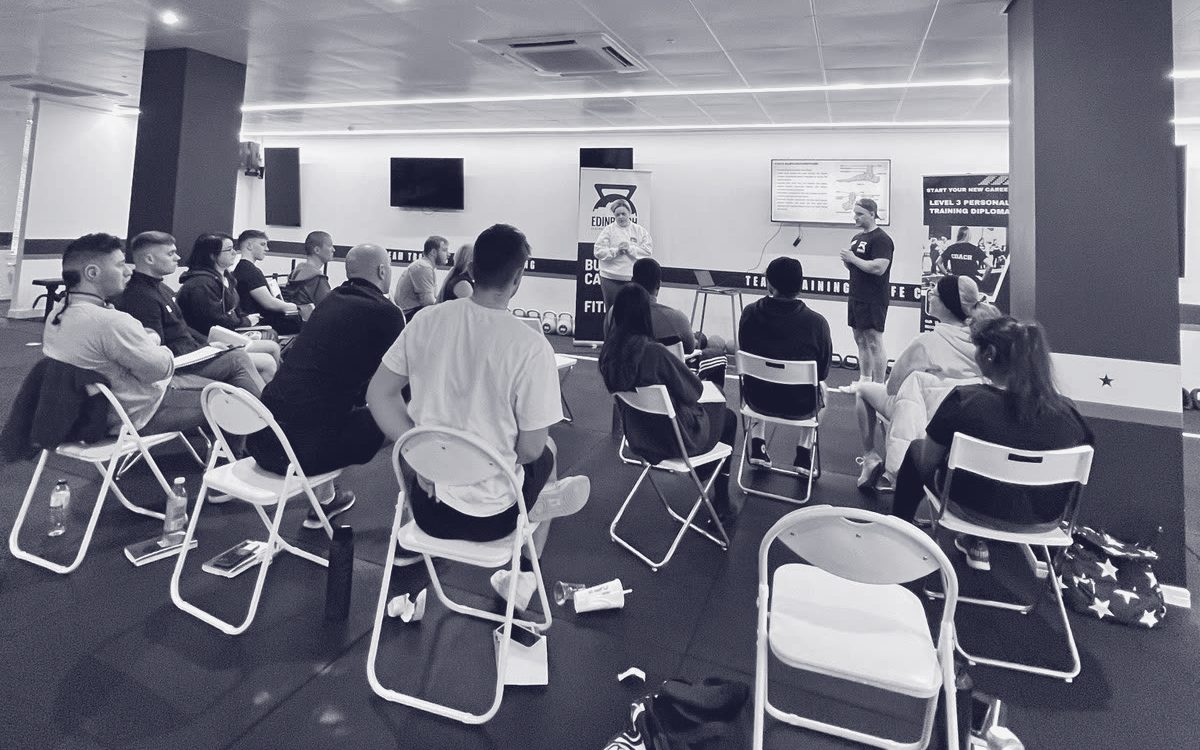
Practical sessions are where you practise coaching on real people, usually your fellow students, with a tutor watching and correcting you. You take turns being the coach and the client, so expect to do a lot of the exercises yourself.
On our course, for example, Week 2 is built around 10 screening stations covering posture, squat, shoulder, hinge, balance, core control and basic cardiovascular findings. Students rotate through them in pairs while a tutor listens to how each one explains what they're seeing. Spotting a limitation is only half the skill; explaining it to a nervous client without alarming them is the other half. Ewa describes a full session in a week on the course.
How a 10-week course builds, phase by phase
| Phase | What you do in the gym | What it prepares you for |
|---|---|---|
| Weeks 1–4: foundations | Warm-ups, 10 screening stations, 9-step programme design, the DECA coaching framework (demonstrate, explain, coach, affirm) | Running a first consultation and writing a safe first programme |
| Weeks 5–7: applied coaching | Upper-body mechanics, kettlebell, calisthenics and pad-work rotations, business ethics and pitching | Coaching different styles of training, and explaining your service to a potential client |
| Weeks 8–10: systems | 30+ lower-body variations, the three energy systems, 15 training methods | Adapting programmes for different goals and progressing clients over time |
Based on the Edinburgh PT Academy 10-week syllabus. Other providers order topics differently, but most cover the same ground.
Time commitment
How much time does a personal trainer course take each week?
Expect far more self-study than contact time. Part-time and online students typically study 8–10 hours a week to finish in around 12 weeks, while full-time intensive courses run Monday to Friday for about 4 weeks.
Qualification specifications show why. One Ofqual-regulated Level 3 Diploma in Personal Training lists 184 guided learning hours and a total qualification time of 414 hours. The difference, about 230 hours, is independent study, coursework and revision that you do in your own time. On a blended course like ours, the 40 hours of in-person gym sessions sit on top of self-paced online theory that you work through between sessions.
Block out study time in your diary before the course starts, especially if you work full-time. Students who plan a few fixed evenings a week usually keep up; students who wait for free time usually fall behind.
Entry requirements
Do you need to be fit or experienced to start a PT course?
No experience is needed for a combined Level 2 and Level 3 course, and you don't need to be an athlete. You do need a reasonable level of general fitness, because you'll take part in practical sessions as both coach and client.
Level 2 courses are usually open from age 16, although some providers set 18 as the minimum; ours does. You'll also need to follow teaching and written assessments in English. If you already hold a Level 2 qualification, you can usually start directly at Level 3. Tell your provider when you apply so they can check your certificate.
Preparation
How should you prepare before your course starts?
You don't need to study in advance, but a little preparation makes the first weeks much easier.
- Learn the basic anatomy terms. Knowing the main muscles, joints and planes of movement before day one makes the early theory far easier.
- Book your study time. Put fixed study sessions in your diary for the whole course, not just the first week.
- Sort your kit. Comfortable training clothes and trainers, a water bottle and a notebook for practical sessions.
- Line up practice clients. A friend or family member who'll let you practise screening and coaching them between sessions is invaluable, and on online-only courses you'll need one for your filmed assessment.
- Check your gym access. Online-only courses expect you to find your own gym for practicals. Blended and in-person courses provide the venue.
Support
What support do you get during a PT course?
Support varies a lot between providers, so ask before you enrol. Online-only providers usually offer tutor support by phone, email, live chat or video call, sometimes seven days a week. Blended and in-person courses add face-to-face feedback during practical sessions.
Class size matters as much as the support channel. A tutor watching 30 students can't correct each person the way a tutor with a small group can. Our cohorts are capped at 8–12 students, with both tutors, James and Ewa, on the gym floor, and students keep lifetime access to the online portal resources.
After the course
What happens after you pass a personal trainer course?
Once you pass, you receive your qualification certificate and can work as a personal trainer anywhere in the UK. Before you train paying clients, you'll need insurance and a first aid certificate that includes CPR.
Many new trainers also join CIMSPA as a Personal Trainer Practitioner. Membership costs £38.94 a year and asks you to complete 10 CPD points a year to keep your knowledge up to date. From there, most people either apply for employed gym roles or start building their own client base. If you're switching from another job, our career change guide sets out how to make that move without losing your income.
Frequently asked questions
Is a personal trainer course hard?
It's manageable for most people, but it takes steady work. Many students find the anatomy and physiology content the hardest part, and keeping up with self-study matters more than natural ability.
What happens if I fail an assessment?
Most providers let you resubmit coursework or resit an exam. Some include resits in the course fee and others charge for each attempt, so check before you enrol.
How long is a personal trainer course?
Most combined Level 2 and Level 3 courses take 10–16 weeks part-time. Full-time intensive courses can take about 4 weeks, and online courses usually give you up to 12 months.
Can I do a PT course while working full-time?
Yes. Part-time, blended and online courses are designed around full-time jobs. Plan for about 8–10 hours of study a week, plus any in-person sessions.
Do I have to be really fit to do a PT course?
No. You need reasonable general fitness to join in practical sessions, but you don't need to be an athlete or have an ideal physique.
Is there a lot of maths or science on a PT course?
There's some science, mainly anatomy, physiology and nutrition, taught from the basics. The maths is simple, such as working out training loads and heart-rate zones.
What should I wear to practical sessions?
Wear comfortable gym clothes and trainers you can train in. You'll take part in the exercises as a practice client as well as coaching others.
Do I need my own gym membership during the course?
It depends on the format. Online-only courses usually expect you to arrange your own gym access for practicals, while blended and in-person courses provide the venue.
Will I get a job straight after the course?
Some students do, but most spend the first months building experience and clients. A course that teaches pricing and client acquisition helps shorten that period.
What's the difference between the online theory and the practical sessions?
The online theory teaches the knowledge, such as anatomy, nutrition and programming principles. The practical sessions teach you to apply it with a real person in front of you, with a tutor correcting you.
Related reading
Keep exploring
Course guide
A Week on the Edinburgh PT Academy Course
One week of the course, told from the gym floor.

Comparison
Level 2 vs Level 3 Personal Training
What each qualification covers, and whether you need both.
Career change
Personal Trainer Career Change in Scotland
A plan to switch careers without losing your income.